
When do they take place? Can we attend as a foreigner? How do you behave to be welcome? This comprehensive guide answers all your questions about the rites of initiation Bassari (Koré) and Bédik (Manindam): the most fascinating ceremonies in Eastern Senegal.
 Contents
- Who are the Bassari and the Bédik?
- The Koré rite in the Bassari
- Manindam in the Bédik
- Comparison: Bassari vs Bédik
- Map of initiation sites
- When to come? Dates and periods
- Can we attend as a foreigner?
- How to behave: practical advice
- Organize your visit from Kédougou
- Frequently Asked Questions
1. Who are the Bassari and the Bédik?
Nestled in the hills and plateaus of Eastern Senegal, the peoples Bassari and Bedik are among the most preserved communities in West Africa. Together, they represent just 2% of the Senegalese population – but a cultural heritage of extraordinary wealth.
The Bassari (or A-Liyan, « those of laterity ») live mainly in the area of Salemata (Ebarak, Ethiolo, Egnissara or Oubadji), west of Kédougou. Animists in the vast majority, they resisted for centuries the pressures of Islamization. Their own language, the Niyan, belongs to the Tenda group. Farmers of the fonio, this sacred cereal, they perpetuate a social organization organized around age classes and a society of male initiation, the Koré.
The Bedik (or « People of the Happy Valley ») live perched on the slopes of the hills around Bandafassi, in villages like Iwol, Andiel, Bantata or Inéré, accessible only on foot. Practicing a syncretism mixing animism and Catholicism, they speak menik and celebrate each year their own initiatory rite: the Manindam.
The Basque Country, which includes the cultural landscapes of the Bassari, Bédik and Peulh, is registered in the UNESCO World Heritage Since 2012. This recognition underlines the exceptional importance of these living traditions.
2. The Koré rite in the Bassari
Bassari initiation is much more than just a ceremony: it is the founding passage that transforms a boy into a responsible man, capable of hunting, founding a family and participating fully in the life of the community.
Who is initiated and at what age?


Only boys who have reached the age of Minimum 12-13 years may cross this threshold. The initiation is not carried out individually: the candidates form an age class, initiated collectively. The company Koré counts three levels of adulthood, each lasting six years and marked by its own rite.
What happens during the rite
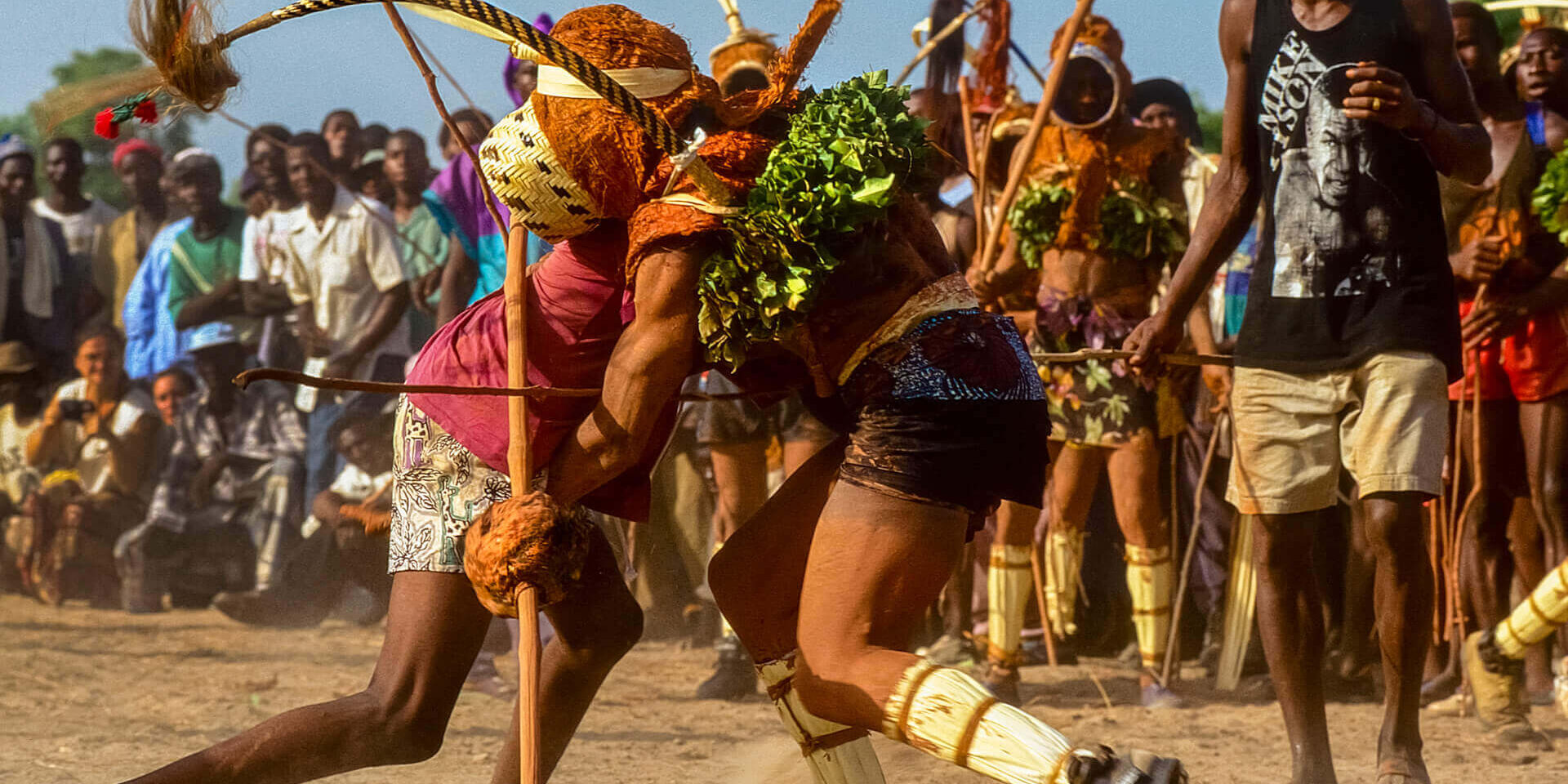
Young initiates are taken out of the village, into the bush, under the exclusive guidance of adult men. There they are confronted with trials of courage and physical strength, in this case fighting. These tests involve the spirits of the Loukuta cave, represented by large circular masks made of raffia and clay, ritual objects whose exact meaning is jealously guarded by the initiatory society.


Initiation dances typically begin at sunset and extend until dawn. The women and elders of the village stay nearby, chanting songs that accompany the passage.
The secret at the heart of the rite


The meaning of masks and rites is a secret transmitted only between initiated men. The hexagonal patterns characteristic of the Bassari masks would be linked to the hierarchy of knowledge within the Koré society. This secret is one of the reasons why foreigners attend outside ceremonies, at a respectful distance.
3. Manindam in the Bédik
At the Bédik, the initiatory ceremony bears the name of Manindam (or Manidam). It also marks the transition from adolescence to adult malehood, but in a distinct cultural setting, tinted with Bédik-specific syncretism.
A rite anchored in the sacred forest
Unlike Bassari initiation very focused on physical tests, Manindam Bédik is intimately linked to the spirits of the sacred forest. Masks and costumes used in ceremonies are entirely made from plant materials harvested in these forests and made especially for each event. They are never kept from year to year.


What few visitors imagine is the physical extent of the rite. Photographer Janis Miglavs, who lived as close as possible to the community of Iwol, documented from inside: for a whole month, the boys of 12 and 13 years run all day through their village, on a precise and immutable route. At the end of this first cycle, they leave the village to reach the bush, where they will live alone during five months. Chief Keita told him that all this has one purpose: to teach boys « the secrets of life ».
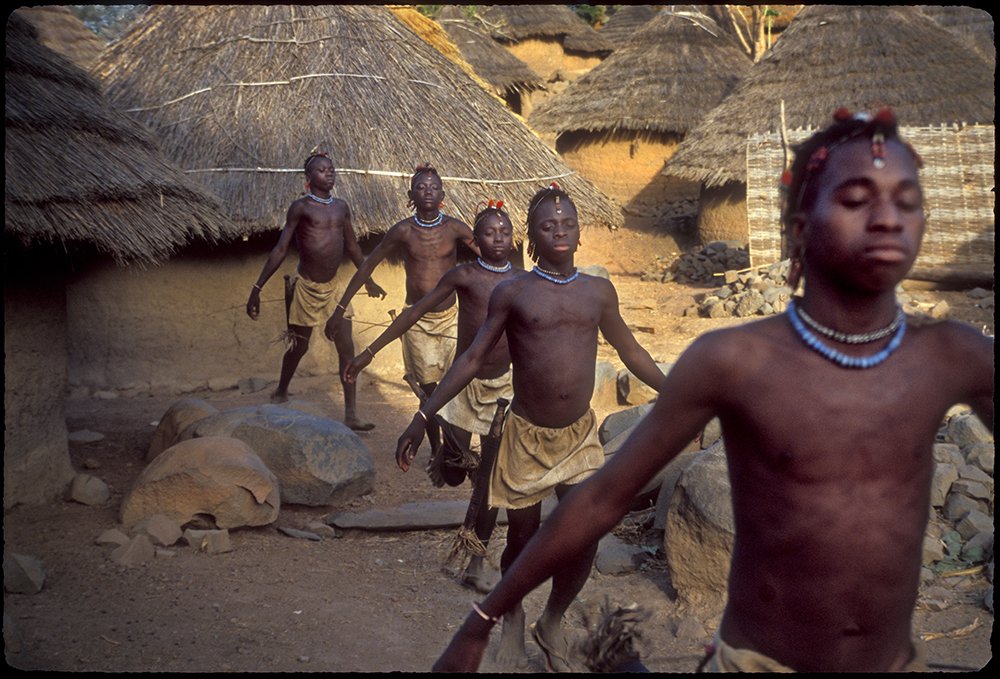
Young insiders Bedik – Janis Miglavs
The social organization of the village Bédik
The daily life of Bédik takes place in scattered hamlets, but the perched village is reserved for parties and rituals. During the initiation period, it becomes again the nerve centre of the community. Each village is divided into two distinct parts (high and low), and families organize around theiyanga, extended family unit.
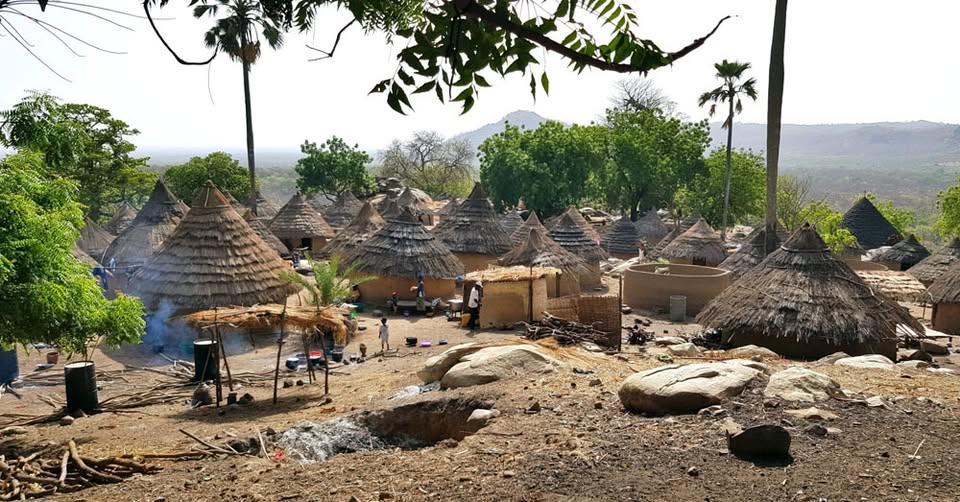
Village bedik
Some Bédik villages such as Andiel, Etwar, Inere, Bantata or Etties are generally closed to foreigners during the initiation period. Others, like Iwol, allow an outside presence with the permission of the village chief. A local guide is essential to negotiate access and comply with the rules in force.
4. Comparison: Bassari vs Bédik initiation
| Criteria | 🥁 Bassari (Koré) | 🌿 Bédik (Manindam) |
|---|---|---|
| Period | April – May (mid-April to mid-June) | April – May |
| Age of initiates | From 12 to 13 years | Adolescents |
| Duration | Several days (night dance) | Several days |
| Masks | Raphia and clay (hexagonal motives) | Plant materials of the sacred forest |
| Spiritual framework | Animism (Lukuta spirit) | Animist-Catholic syncretism |
| Access for foreigners | Partial, with local guide | Variable according to village, with permission |
| Main villages | Oubadji, Salemata, Ethiolo, Ebarak | Iwol, Andiel, Bantata, Inéré |
| Frequency | Annual (by village) | Annual (by village) |
Map of Basari and Bédik initiation sites in Kédougou
5. When to come? Dates and periods
This is the question that every traveller asks first and the answer requires a little nuance.
The initiation ceremonies of the two communities usually take place between mid-April and mid-June, before the arrival of the great rains that mobilize the whole community for the work of the fields. In practice, the most frequent dates are April and May.
The elders of each village set the dates of initiation each year, often shortly before the beginning of the ceremonies. There is no pre-published official calendar. This is why a local contact or a guide to the region is irreplaceable for real-time information.
Note that initiations not held every year in all villages Some villages organize the ceremony every two or three years depending on the availability of candidates. In 2025, for example, two villages in the territory of Oubadji celebrated the initiation in May, while other villages did not organize it that year.
Advantage of this period
April-May falls in end dry season : the tracks are still practical, the heat is intense but can be sustained in the morning, and the vegetation starts to green with the first rains. It is also an excellent time to discover the Dindéfelo waterfalls and hikes in the Basque Country.
6. Can we attend as a foreigner?
Yes! Under certain conditions, and with due respect. The Bassari and Bédik communities do not organize their rites for tourism: they are sacred and deep ceremonies. But they are not closed to the outside world.
Here is what it is generally possible to do as a visitor:
- Attend the nocturnal dances of initiation from the outskirts of the village
- Meet the elders and masters of the initiates (with intermediary)
- Observe the preparations and life of the village during the period
- Participate in the exchanges with the families that invite you
- Photographing, with explicit permission, dances and festive atmospheres
What is strictly reserved for insiders:
- Follow the boys in the bush during the tests
- Approaching or manipulating ritual masks
- Entering spaces exclusively for initiated men
- Photographing without permission, especially intimate ceremonies
The Bassari and Bédik communities are aware of their responsibility to preserve their culture. They appreciate respectful and curious visitors. Coming with a local guide, who speaks the language and knows families, radically changes the experience: you are no longer a visiting tourist, you are a guest.
7. How to behave: practical advice
Clothing
Prefer clothes covering and discreet, Light pants, long shirts. Avoid short short shorts and over-fitting outfits. Bright colours are accepted; white may be associated with mourning in some local cultures, so prefer neutral or lightly coloured tones.
Photographs and videos
Always askauthorization before photographingin particular women, the old and ritual moments. A refusal is respected without discussion. During the most sacred phases of ceremonies, tidy your device and live the full moment.
General behaviour
- Greet the village chief upon your arrival (your guide will charge him)
- Stay away from the forbidden areas without being reminded twice
- Follow the instructions of your local guide in all circumstances
- Accept invitations to share a meal or drink, it's an honor
- Bring a small present to the village chief if you wish (tissue, cola nuts)
Language and communication
Few villagers speak French fluently. A guide speaking bassari or menik (bédik) is essential not only to communicate, but to navigate the cultural subtleties that can make the difference between an accepted visit and an involuntary intrusion.
8. Organize your visit from Kédougou
Kédougou is the natural starting point for joining the Basque Country and the Country Bédik. Here are the key elements for planning well.
Distances and accessibility
- Salemata (heart of the Basque Country): about 80 km from Kédougou, 2h to 3h of track
- Oubadji : entrance door to the Basque Country, 3h car from Kédougou
- Iwol (Bédik main village): accessible from Bandafassi, 30 minutes walk on rocky road
- Bandafassi : 17 km from Kédougou, 30-45 min in 4×4
Why go through a local guide?
A Bassari or Bédik guide from the region is your best asset. He knows the dates in real time, village leaders, unwritten rules and families that welcome visitors. It can alert you in advance if an initiation is imminent, and it is this type of information that you will not find on the Internet.
Since initiation dates are announced late by the elders, it is advisable to schedule at least 3 to 4 days in the region to increase your chances of attending ceremonies. Contact us before you leave for a real-time update of the situation in the villages.
How many days?
| Duration | What You Can See |
|---|---|
| 2 days | Visit of a village Bédik (Iwol) + preparation of initiation if in season |
| 3-4 days | Country Bédik + Netherlands + real chances of attending ceremonies |
| 5-7 days | Complete immersion: villages, ceremonies, Dindéfelo waterfalls, hiking |
9. Frequently Asked Questions
Would you like to attend the initiations? Our local guides Bassari and Bédik are in direct contact with the villages. We inform you in real time of the dates and accompany you to experience this unique experience in the best conditions.